Inclusive procurement: are we giving the right businesses a chance?
Amarachi Edison
12 Kasım 2026
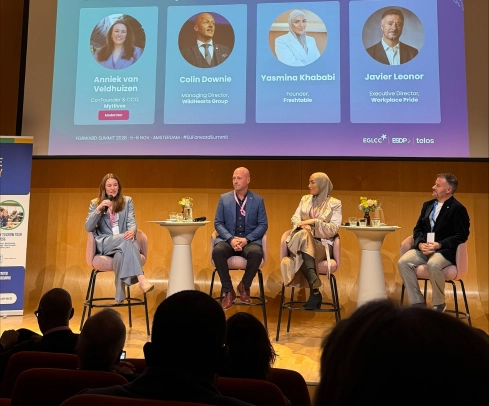
A procurement process can look fair on paper and still exclude good businesses. That is one of the uncomfortable realities behind the conversation around inclusive procurement and supplier diversity. At the recent Forward Summit at the World Trade Center Amsterdam, organised by ESDP, EGLCC and telos, our co-founder Anniek van Veldhuizen joined Javier Leonor, Executive Director of Workplace Pride, Yasmina Khababi, founder of Freshtable, and Colin Downie, Managing Director of WildHearts Group, for a discussion on what it takes to build a business when you do not fit the usual picture, and what corporate buyers can do differently. The room brought together corporate buyers and suppliers, making the conversation particularly relevant: inclusion is not only about who gets invited into the room. It is also about what happens once they get there. And that raises a bigger question: Are our procurement systems creating genuine opportunities for new suppliers, or simply asking more businesses to fit into systems that were never designed with them in mind?
Procurement is more than a checklist
Procurement exists to help organisations manage cost, quality, risk and supplier performance. Those objectives are important. But procurement processes can also unintentionally favour businesses that already understand the system. Established suppliers often have the track record, resources, certifications, relationships and capacity needed to navigate lengthy procurement processes. Smaller or less established businesses may have the capability to deliver but struggle to get through the process in the first place. This creates a gap between being capable of doing the work and being given the opportunity to prove it. That distinction matters. If the same types of suppliers continue to enter the same procurement networks through the same channels, businesses outside those networks can remain invisible, regardless of the quality of what they offer. Inclusive procurement requires more than finding diverse suppliers. It requires looking at the door itself. Who can access it? What does it take to get through it? And are all of those requirements genuinely necessary?
Four lessons from the Forward Summit conversation
The panel offered perspectives from both sides of the supplier-buyer relationship. While the experiences differed, four themes stood out. 1. Sometimes one opportunity is all it takes to change the trajectory: Think about your own career or business journey. Someone often said yes before you had a long track record. Someone who took the meeting, made the introduction, trusted your potential or gave you an opportunity to demonstrate what you could do. The same principle applies to supplier relationships. For a business trying to enter a new market or break into corporate supply chains, the first contract can be disproportionately important. It creates a reference, builds credibility and provides evidence that can make the next opportunity easier to win. This is why supplier diversity cannot rely entirely on asking businesses to become more procurement ready. Buyers also have a role to play in creating the first opportunity. The challenge for procurement leaders is to ask: Who has the capability to become a valuable supplier but has not yet had the opportunity to demonstrate it? That question can reveal to suppliers that conventional sourcing methods may never find. 2. Risk management should not become a barrier to discovery: Corporate procurement understandably focuses heavily on risk. There are financial risks, operational risks, compliance requirements, security considerations and reputational risks to manage. But risk management can become counterproductive when every potential supplier is expected to demonstrate the same scale, history and credentials as an established provider before they are given an opportunity. Colin Downie's point during the discussion was particularly relevant here: corporates can afford to be braver. That does not mean abandoning due diligence. It means finding ways to test new relationships without taking unnecessary risks. A small pilot can be one answer. Instead of immediately committing to a large contract, a buyer can start with a defined project, establish clear measures of success and evaluate the relationship based on actual performance. If it works, expand it. This creates a more practical balance between risk management and supplier discovery. The question should not always be, "Can this supplier prove they can handle everything we need today?" Sometimes it should be: "Can we create a controlled opportunity for them to prove what they can do?" 3. Suppliers have to recognise the value they bring: There is another side to inclusive procurement that is sometimes overlooked. The responsibility does not sit entirely with corporate buyers. Yasmina Khababi spoke about the importance of owning your place, particularly when others may not immediately recognise it. For businesses operating outside traditional networks, entering a room where they are underrepresented can require confidence as much as capability. That means being clear about your value proposition. What problem do you solve? What makes your approach different? What evidence can you provide? Why should a buyer consider you? Supplier diversity works best when inclusion and capability meet. Creating access matters, but suppliers also need to be ready to communicate their value and take ownership of the opportunities available to them. The goal is not to wait until everyone else decides that you belong. Sometimes, you have to show up knowing that you do. 4. Inclusive procurement becomes more complex across borders: The further a business expands, the easier it becomes to assume that what worked in one market will work somewhere else. It often does not. Javier Leonor highlighted the importance of understanding how rules, expectations, norms and approaches to inclusion can differ between countries. This is particularly important for European businesses operating across multiple markets. Regulatory requirements may differ. Business cultures may differ. Expectations around diversity and inclusion may differ. Even the way relationships are built and purchasing decisions are made can vary. Cross-border procurement therefore requires more than translating a strategy from one market into another. It requires listening first, researching the market, understanding the local context, asking questions, test assumptions, then adapting. Taking that approach may require more time at the beginning, but it can prevent much bigger problems later.
What can corporate buyers actually do?
The conversation around inclusive procurement becomes meaningful when it leads to practical changes. Corporate buyers can start by examining their existing procurement process and asking a few straightforward questions:
- Are we reaching suppliers outside our existing networks?
If supplier discovery depends heavily on existing relationships and referrals, new businesses may never enter consideration.
- Which requirements are essential, and which are simply familiar?
Every requirement should have a purpose. If a particular qualification, contract size or years-in-business requirement does not materially reduce risk, it is worth questioning whether it needs to remain a barrier to entry.
- Can we create smaller entry points?
Pilot projects, smaller contracts and phased engagements can give buyers a way to assess new suppliers without taking on unnecessary exposure.
- Are we measuring supplier diversity beyond recruitment?
Adding diverse suppliers to a database is not the same as creating meaningful commercial opportunities. Organisations should also look at engagement, contracts awarded, spend and supplier retention.
- Are we making it clear how new suppliers can engage with us?
A supplier cannot compete for an opportunity they cannot find or understand. These are not complicated questions. But they can expose where a procurement strategy is genuinely inclusive and where it simply looks inclusive from the outside.
Inclusive procurement is not about lowering standards
This is perhaps the most important distinction. Supplier diversity does not mean lowering procurement standards. It means examining whether the route to those standards unnecessarily excludes capable businesses. A smaller supplier should not receive a contract simply because it is diverse. But neither should a capable supplier be automatically excluded because it has not yet had the opportunity to build the same track record as an established competitor. There is a difference between reducing standards and removing unnecessary barriers. That distinction should sit at the heart of any serious inclusive sourcing strategy.
Building a more inclusive procurement system starts with a different question
The conversation at Forward Summit left us with a simple but important challenge. Instead of asking only: "Does this supplier fit our existing process?" What if organisations also asked: "Does our process give capable suppliers a fair opportunity to show what they can do?" That shift changes the conversation. It moves inclusive procurement away from being purely about representation and towards access, opportunity and better business decisions. One buyer can take the first meeting. One procurement team can test a smaller contract. One supplier can decide to step into a room and own its value. One organisation can question a requirement that has always been there simply because it has always been there. Those individual decisions may seem small. Collectively, they can change who gets to participate in the supply chains shaping our economies. Because sometimes the problem is not that the right businesses are missing. It is that we have not built a procurement process that knows how to find them.